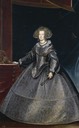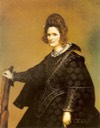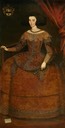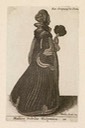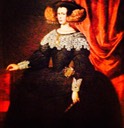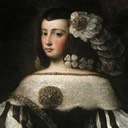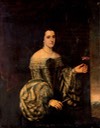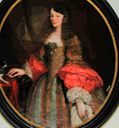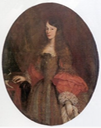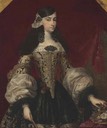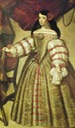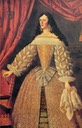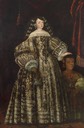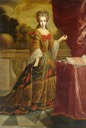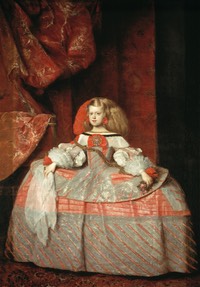
Spain appears to have done what the USA is doing today, refused to change as the world caught up with it and then left it behind. This obstinence also showed up in fashion. Fashion then was more serious business than it is today because it served the role of advertising the wearer's, and family's/country's, power and wealth and as an aid in seduction, helping a woman find the best opportunity for her one available career. But Iberian style had a final burst of glory as depicted by Diego Velázquez and others. But it was old when Catherine of Braganza wore farthingales to Charles II's court in 1662. Iberian style closely followed French style in the 1700s with a few exceptions, such as the maja style.
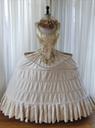
But then following French style may not have been difficult because the Bourbons (Borbóns) took over from the Habsburgs and the French followed the tontillo style with supports called panniers throughout most of the 1700s.
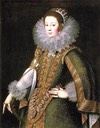
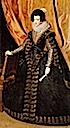
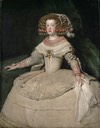
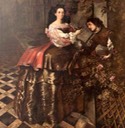
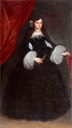
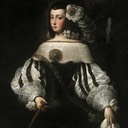
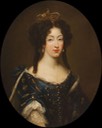
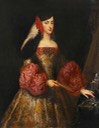
Unknown Lady at the court of Philip IV previously called Isabella Bourbon by the school of Diego Valazquez (Royal Collection)
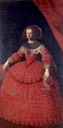
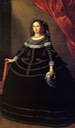
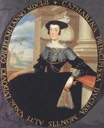
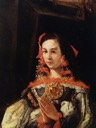
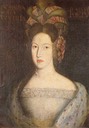
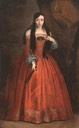
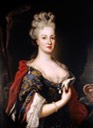
Infanta Joana de Bragança, princesa da Beira by ? (attributed to Manuel Franco) (Museu de Évora - Évora, Évora, Portugal)
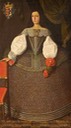
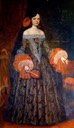
1660s Ines de Zúñiga, condesa de Monterrey by Juan Carreno de Miranda (Fundacion Lazaro Galdiano - Madrid Spain)
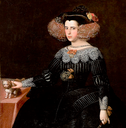
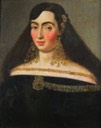
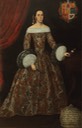
1665-1670 Doña Francisca de Velasco, Marquesa de Santa Cruz by Juan Carreño de Miranda (private collection)
ca. 1670 Maria de Vera y Gasca by Juan Carreño de Miranda (Banco Bilbao Vizcaya Argentaria - Bilbao, Vizcaya, Spain)
Unknown Lady by Bartolomé Esteban Murillo (Philadelphia Museum of Art - Philadelphia, Pennsylvania, USA)
ca. 1675 Doña Isabel Diaz de Morales Muñiz de Godoy y Aguayo by Juan de Alfaro y Gamez (Museo de Bellas Artes de Bilbao - Bilbao, Bilbao, Spain)
ca. 1677 Felice de la Cerda y Aragón, Marquesa de Priego by Juan Carreño de Miranda (Hospital Tavera, Toledo Spain)
Duquesa de Híjar by Juan Bautista del Mazo (Museo de la Real Academia de Bellas Artes de San Fernando - San Fernando Spain)
Doña Josefa Benavides, Marquesa de Villena, wife of Don Juan Manuel López Pacheco, 8th Duke of Escalona and 8th Marquis of Villena by Alonso Miguel de Tovar (location unknown to gogm)
ca. 1683 Dama de la Casa de Medinaceli (la Duquesa de Feria?) by Juan Carreño de Miranda (Hospital Tavera, Toledo Spain)
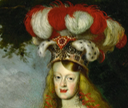
ca. 1683 Dama de la Casa de Medinaceli (la Duquesa de Feria?) by Juan Carreño de Miranda (Hospital Tavera, Toledo Spain) head
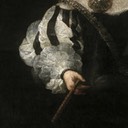
ca. 1683 Dama de la Casa de Medinaceli (la Duquesa de Feria?) by Juan Carreño de Miranda (Hospital Tavera, Toledo Spain) upper body
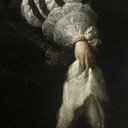
ca. 1683 Dama de la Casa de Medinaceli (la Duquesa de Feria?) by Juan Carreño de Miranda (Hospital Tavera, Toledo Spain) engageantes
1682 (after) María Josefa von Harrach, German noblewoman who was a menina (Lady-in-waiting) to Maria Anna of Austria, Queen of Spain by ? (Hradek Nechanic, Czech Republic)
ca. 1690 Teresa Francisca Mudarra y Herrera by Claudio Coello (Museo de Bellas Artes de Bilbao/Bilboko Arte Ederren Museoa - Bilbao, Vizcaya, Spain)